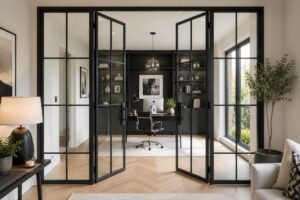
How Can a Bespoke Steel and Glass Door Define a Period Dining Room?
Period homes have a character that is difficult to reproduce. Quarry tile floors, painted brickwork and traditional proportions all deserve careful consideration when introducing new architectural features.
For a period home near Rotherfield in East Sussex, a black steel and glass door offers a way to give the dining room its own identity while keeping the original materials in view. Unlike a solid timber door, glazed steel framing preserves sightlines and allows daylight to move between adjoining spaces.
The appeal is simple: a more defined dining area without making the surrounding rooms feel closed off. The result depends on thoughtful proportions, suitable glazing and a door designed around the existing opening.
Why Does a Black Steel and Glass Door Suit a Period Home?
Black steel creates a restrained contrast with the warmth of quarry tiles and the texture of painted brick. Slim profiles help the door feel like a considered architectural addition rather than an attempt to imitate older joinery.
The glazing-bar layout is especially important. Too many divisions can overwhelm a modest dining room; carefully positioned bars can echo the proportions of traditional windows and nearby openings. A durable powder-coated finish gives the frame a clean appearance without competing with the existing materials.
For homeowners interested in this style, our Ultra Slim Steel & Glass Doors Collection provides examples of the available design approach. These are standard non-fire-rated internal door designs, not automatically fire-rated doorsets.
How Can the Door Preserve Quarry Tiles and Painted Brick?
The junctions between a new door frame and old surfaces deserve as much attention as the door itself. Period floors can be uneven, while painted brick walls may need careful assessment before fixings are chosen.
Accurate surveying helps establish opening dimensions, floor levels, wall alignment and the space needed for the door to swing. The fixing method should be selected for the actual substrate, with particular care around historic or difficult-to-replace materials.
A made-to-measure steel door can accommodate the proportions of an existing opening more elegantly than a standard-size product. However, bespoke manufacturing does not remove the need for sound installation planning, especially where original finishes must remain undisturbed.
Can a Glazed Steel Door Give the Dining Room More Privacy?
Yes. A hinged steel and glass door creates a physical boundary between the dining room and neighbouring areas while maintaining a visual connection. When closed, it can help separate everyday activity without sacrificing the openness that makes glazed interiors attractive.
This is particularly useful in broken-plan homes, where rooms have distinct purposes but still share natural light. A door can offer more control than a permanently open doorway, although it should not be assumed to provide acoustic isolation.
If noise reduction is important, discuss the glass, perimeter seals, threshold and adjoining walls as a complete system. The finished performance depends on more than the steel frame alone.
Which Glass Works Best for a Period Dining Room?
Clear glass is often the most suitable choice when the goal is to preserve views of quarry tiles, painted brick and other original details. It also helps daylight reach areas that might otherwise feel enclosed.
Reeded or fluted glass can provide a softer division and more visual privacy, although it will also obscure some of the character visible through the doorway. The appropriate safety-glass specification depends on the door design and glazing position; ordinary glass should never be assumed suitable simply because it looks attractive.
A black steel frame with clear safety glazing is therefore a strong starting point for many period interiors, subject to the specific project requirements.
What Should You Check Before Ordering a Bespoke Steel Door?
Start with the practical layout. Check the proposed opening direction, furniture clearance, handle position and the way the frame meets the existing floor and walls. An attractive door should also be comfortable to use every day.
If the property is listed, alterations affecting its special interest may require listed building consent. Fire-safety requirements must also be considered where a doorway forms part of a protected escape route or fire-resisting enclosure. A standard internal steel and glass door should not be represented as fire-rated.
Totally Steel Doors can discuss the opening, glazing and finish before preparing a project-specific quotation. That early conversation is particularly valuable for older buildings with irregular dimensions or sensitive finishes.

Conclusion: A Steel Door That Respects the Original Interior
A bespoke black steel and glass door can help a period dining room feel separate and purposeful while preserving views of its original quarry tiles and painted brickwork. Rather than replacing the character of the property, slim steel framing introduces a contemporary detail that works alongside it.
The best outcome comes from treating the existing building as the starting point. Proportions, glass selection, opening direction and fixing details should all respond to the room. For period homes around Rotherfield and across East Sussex, a made-to-measure approach offers a practical way to balance everyday use with architectural character.
Discuss Your Project with Totally Steel Doors
Based in Orpington, Kent, Totally Steel Doors specialises in bespoke steel and glass doors, internal glazing and architectural partitions. We work across East Sussex, London, Kent, Surrey, Essex and the wider Home Counties, as well as selected projects throughout the UK.
Use our Online Configurator to explore your ideal steel door, partition or fixed glazed panel, or contact our team to discuss your project and request a quotation.
Telephone: 020 3649 6080
Email: sa***@******************co.uk
Website: www.totallysteeldoors.co.uk